
CrashControl - Daily performance & recovery system
Crush your workouts. Don’t crash the next day
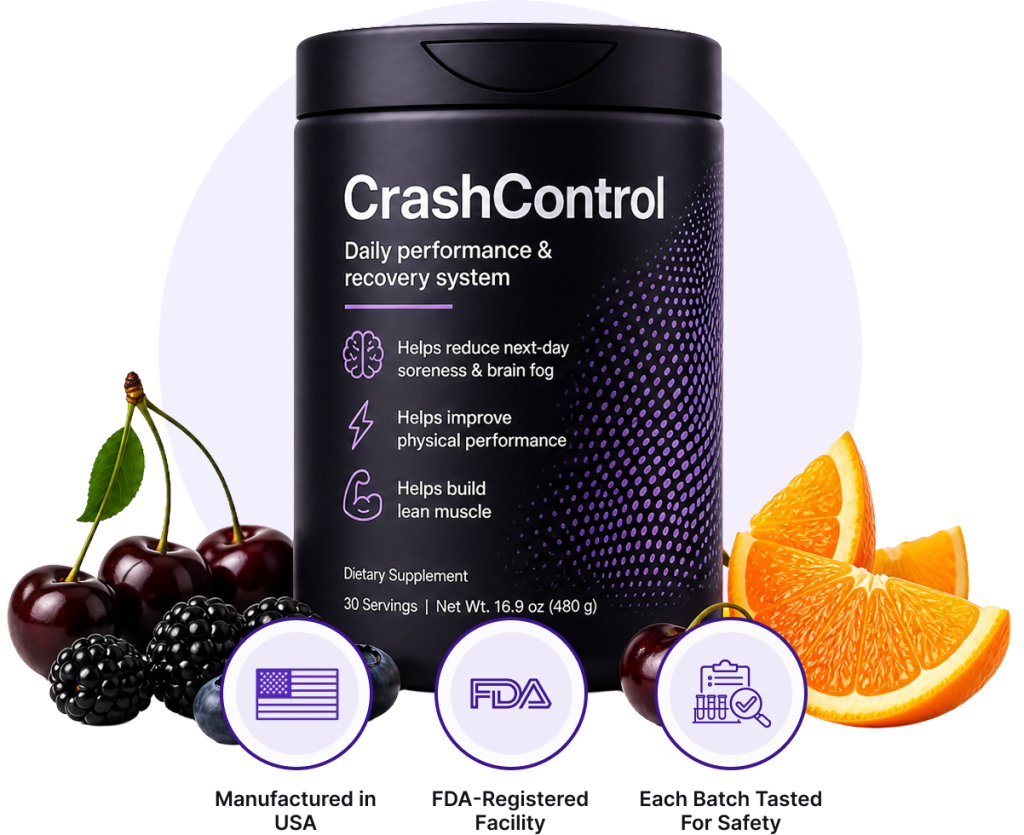
A daily system built to keep your body performing without the usual fatigue, soreness, and mental fog that stack up over time.
Replaces your 3-8 bottle stack with one complete daily system. No messy dosing, no overlapping ingredients, no guesswork.
- Helps reduce next-day soreness & brain fog
- Helps improve physical performance
- Helps build lean muscle
First production run will be limited, and priority will be given to pre-launch list subscribers.
First Batch Ships: Mid-July 2026
Are Your Workouts Costing You the next day?
You train hard because you want results. You want to get stronger, build muscle, push yourself.
But then comes the next day…
You wake up and feel it more than you expected: Your body feels heavier, slower.
Mentally, you’re not as sharp as you should be. Not destroyed… but not at your best either.
And that’s where the problem starts.
Because your workouts are no longer staying in the gym.
They start showing up in your work… your energy… your mood… your ability to focus.
And over time, that tired feeling starts to stick around.
You’re not just sore after workouts anymore. You’re tired in general.
Tasks that should be easy start taking longer. Your focus is off. And you’re not getting through work with the same speed or sharpness you used to.
You start saying “no” to plans and activities you used to enjoy. Not because you stopped caring, but because you’re too drained to bother.
And after a while, it starts to feel like a motivation or discipline problem.
But it isn’t…

It’s Not Your Motivation or Discipline. It’s Poor Recovery
It’s not that you suddenly became lazy.
It’s fatigue adding up with each training session because your body doesn’t get a proper reset.
You might think you’re doing everything right. But proper recovery isn’t just protein, sleep, or one good habit. It’s a chain reaction inside your body.
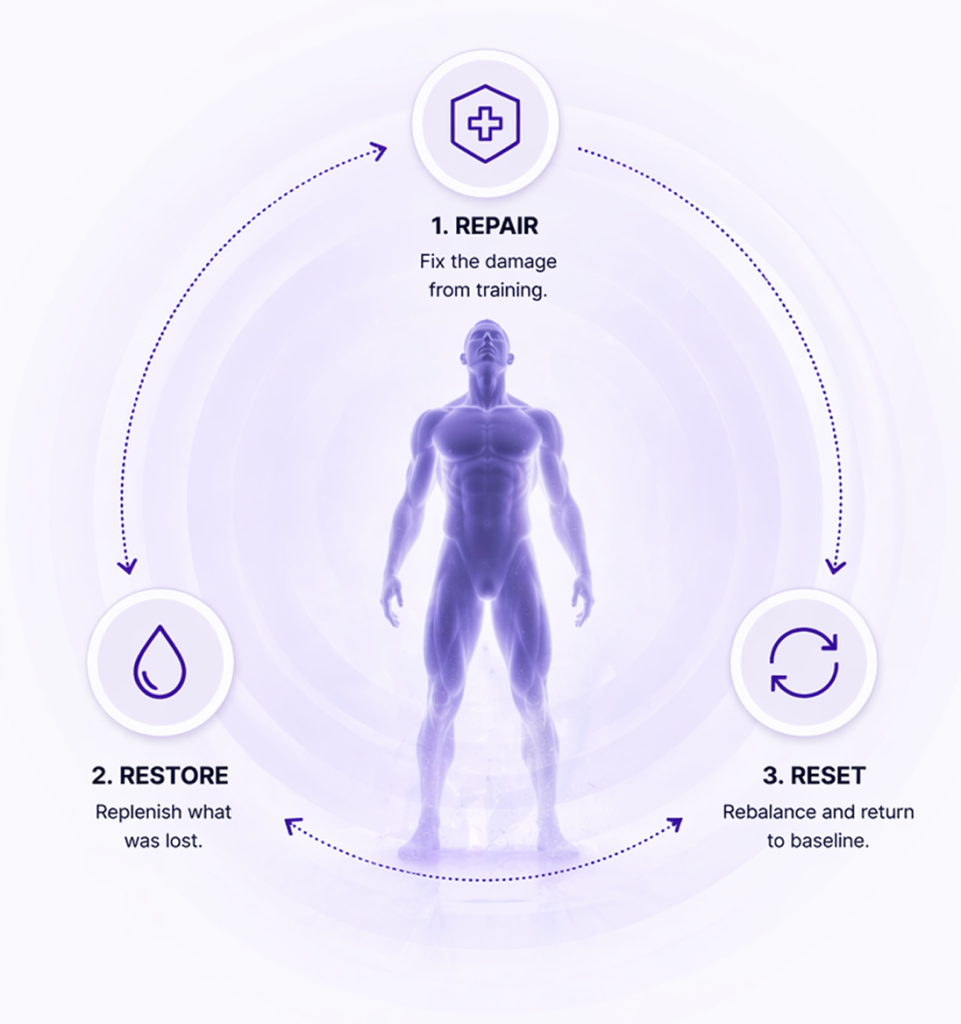
When you train hard, your body has to:
– repair damage
– restore what was lost
– return to baseline
And if even one part of that chain is under-supported, the whole system slows down.
Not enough to stop recovery completely. But enough for you to feel it the next day.
And if you’re like most people, that’s what you’re stuck with because no one ever gave you a recovery system that is:
– complete
– simple
– easy to follow every day
So you end up doing what most people do: trying random things, hoping something finally works.
And The Industry Is Not In a Rush To Give You a Solution
Because most supplements aren’t built to solve the full problem.
They’re built to:
– sell fast
– sound impressive
– and fit neatly into a category
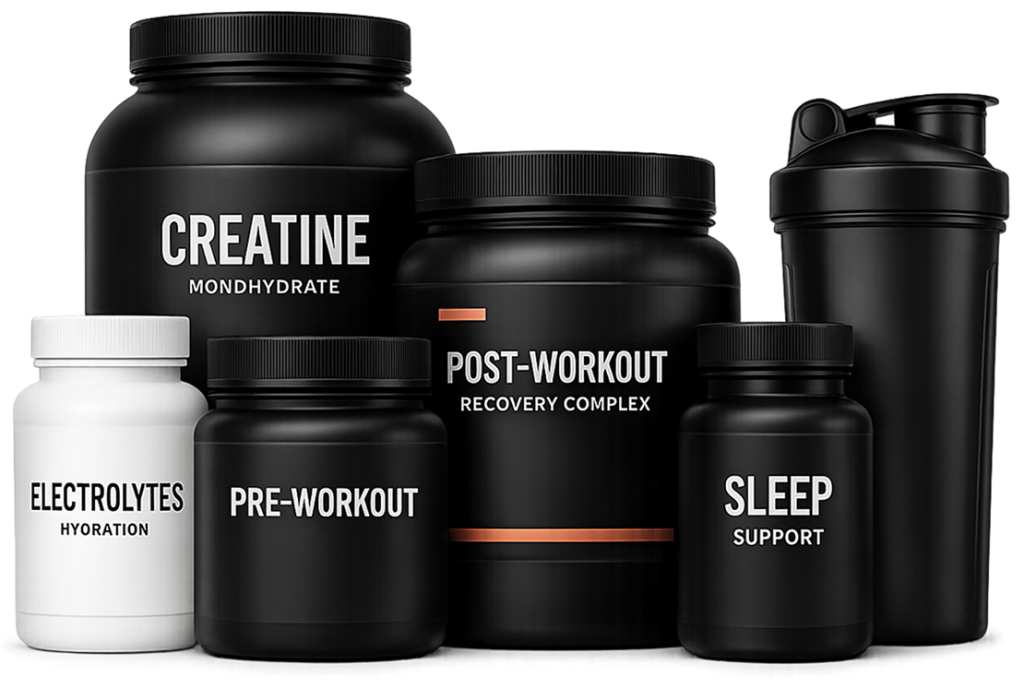
So you end up with a stack that looks like this:
– pre-workout for energy
– post-workout for recovery
– electrolytes for hydration
– something “extra” for sleep and soreness
Three… five… sometimes eight different products.
Each one doing part of the job. None of them solving the whole system.
And it gets worse…
Because most of these products are:
– Underdosed: the right ingredients, in amounts too small to matter
– Built around hype: BCAAs, proprietary blends, exotic compounds that sound better than they perform
– Designed to be stacked: not because they need to be… but because that’s how you’re sold more products
So you end up with:
– multiple bottles
– inconsistent intake
– overlapping ingredients
– and still… incomplete recovery
So instead of adding to the noise… we removed it
Before deciding what to include in CrashControl, we asked a better question: What does not belong in a daily performance and recovery system?
Because the goal was never to make the label look impressive. The goal was to build something you can take every day that actually supports performance, recovery, hydration, and next-day function.
That means no trendy ingredients that just sound cool. No underdosed “fairy dust.” No junk added just to make the label look complete.
And a few popular supplement categories did not make the cut:
#1 Caffeine
Caffeine is the most important ingredient in most pre-workout formulas.
And these formulas are built around one thing: Stimulation, not performance.
Most of them rely heavily on caffeine to make you feel like the product is working.
And to be fair, they do increase alertness and short-term energy.
But that’s not the same as improving recovery or long-term performance.
You get energy spikes followed by crashes and disrupted sleep, even if you don’t fully notice it.
And that directly hurts recovery.
So you end up in a loop: Take stimulants to train harder, recover worse, then need more stimulation next time.
#2 BCAAs (Branched-Chain Amino Acids)
If you’ve ever looked for recovery products, you’ve definitely seen them.
Because for years, the industry has told you: “Recovery = BCAAs.”
And part of it is true.
Research indicates that BCAA supplements can reduce muscle soreness and some blood markers of muscle damage after hard workouts.
However, the benefit is moderate, not guaranteed, and does not reliably translate into faster performance recovery.
Because complete recovery requires all 9 essential amino acids. BCAAs contain only 3.
And the most surprising part for most people: You’re probably already getting BCAAs every single day.
If you eat meat, eggs, dairy, protein bars, or protein shakes, you’re likely getting plenty of BCAAs as part of your total protein intake.
And according to a 2018 study published in the Nutrients Journal, “when consumed with a diet consisting of 1.2 g/kg/day protein and presumably higher daily protein intakes, it appears BCAA effects on muscle recovery are negligible.” [1]
So should you really keep taking them?
#3 Glutamine
Glutamine is one of those supplements that used to be everywhere.
Back in the day, if you walked into a supplement store, glutamine was almost always part of the “serious lifter” stack.
It was believed to help build more muscle and improve recovery.
But over time, as more research came out, those original claims didn’t hold up.
For example, a 2001 study published in the European Journal of Applied Physiology concluded that ”glutamine supplementation during resistance training has no significant effect on muscle performance, body composition or muscle protein degradation in young healthy adults.” [2]
Another example: a 2005 study published in Medicine & Science in Sport & Exercise also concluded: “Glutamine supplementation does not increase muscle strength or significantly change body composition following resistive training.” [3]
In other words, it’s not the missing piece for getting better results from your workouts.
That’s why, despite how popular it used to be, glutamine is no longer considered a key supplement for muscle growth or recovery.
#4 HMB
HMB is another supplement that had its moment.
In the early 2010s, it was heavily promoted as a breakthrough for muscle growth and recovery.
Some early studies reported unusually large gains: up to 7.4kg of lean body mass over a 12-week period. [4]
Understandably, those results got a lot of attention. And for a while, HMB was positioned as a kind of “next-level” supplement.
But as more research came out, those findings didn’t hold up.
Later studies failed to consistently replicate those large effects, especially in healthy, trained individuals.
When you look at the broader body of evidence today, the results are much more modest:
For example, a 2004 research published in the Journal of Strength and Conditioning Research concluded that “gains in lean mass with HMB are likely to be trivial.” [5]
Another example: a 2020 meta-analysis of 48 studies published in the Nutrients Journal found “no substantial effect on muscle strength in adults aged 18–45 years.” [6]
So HMB’s real-world impact is much smaller than the early hype suggested.
If you’re training regularly, eating enough protein, and generally healthy, HMB is not a limiting factor for your performance or recovery.
#5 Beta-Alanine
Beta-alanine is one of the few “hyped” ingredients that actually does something. But not what most people think or want.
In simple terms, it helps delay that “burn” feeling when you’re pushing hard. There is solid research behind this:
The International Society of Sports Nutrition states: “Daily supplementation with 4 to 6 g of beta-alanine for at least 2 to 4 weeks has been shown to improve exercise performance, with more pronounced effects in tasks lasting 1 to 4 minutes.” [7]
Because of how it works, beta-alanine is most useful for activities like sprinting, interval training, rowing, or certain types of endurance efforts. That’s why it’s often used by performance-focused athletes trying to improve time or output.
However, the real-world effect is much smaller than the industry often suggests.
In most cases, the improvement is marginal. Seconds, not transformations.
That can be meaningful for high-level athletes competing at the limit, where small performance gains matter.
But for the average person training a few times per week, that difference is rarely noticeable in practice.
The only noticeable effect for most people is the tingling sensation (called paresthesia). Some people like it because they believe it means their pre-workout or post-workout is working.
But if that’s all you feel from the supplements you take… maybe it’s time for a switch.
#6 “Proprietary Blends”
You’ve seen labels like: “Performance Matrix — 3,200mg”
That sounds impressive.
But the problem is nobody, except for the manufacturer, knows what’s inside.
You don’t know:
– what ingredients are inside
– how much of each ingredient is inside
– what effects and side effects you can expect
Some companies claim that their formula is super unique, and “proprietary blend” is how they protect it.
Well, any competitor can buy that supplement, send it to a lab, and find out what’s inside.
So there’s really no reason to do it unless you’re trying to hide underdosing, reduce costs, or make the label look more complete than it really is.
And that’s how a lot of companies end up with the next problem…
#7 “Kitchen Sink” formulas
These are the products that include 30-70 ingredients in tiny amounts.
They look really “complete” on the label. And that makes them easier to sell.
The problem is, your body doesn’t respond to ingredient lists. It responds to effective doses.
And to have 30 ingredients in effective doses might mean 60, 90, 120 or more grams per scoop and 1.8, 2.7, 3.6 or more KILOGRAMS per jar.
A company would go bankrupt just trying to manufacture that “monster supplement.”
And whether that many ingredients at effective doses can actually be absorbed comfortably in one serving is a different question altogether.
So What Actually Fixes Recovery?
Not another random supplement. Not more stimulation. Not a bigger stack.
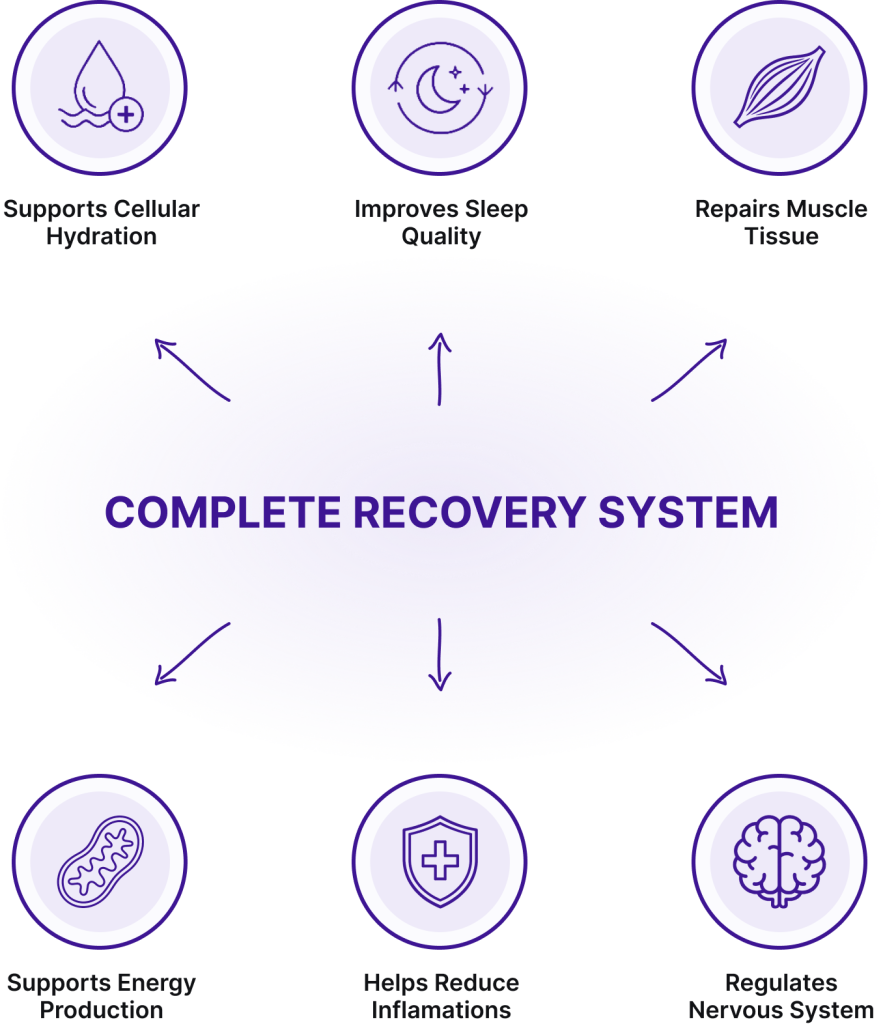
If you want to perform in the gym and outside of it, the solution has to do three things well:
1 – It has to cover the full recovery chain:
– cellular hydration
– energy production
– muscle repair
– nervous system recovery
– inflammation and soreness management
– return to baseline between sessions
Miss one, and the whole system slows down.
2 – It has to be built for daily use
Because recovery does not only happen on the days you feel sore.
It happens every day your body is adapting, repairing, and preparing for the next session.
So the system has to be easy enough to use consistently:
– one daily routine
– no messy stack
– no brutal flavor you dread drinking
3 – It has to improve performance, not just reduce soreness
Feeling less sore is good. But the real goal is bigger than that.
You want to train hard, recover properly, and show up strong again.
That’s exactly what CrashControl was built to do.
A complete daily performance and recovery system that replaces the messy stack with one simple routine.
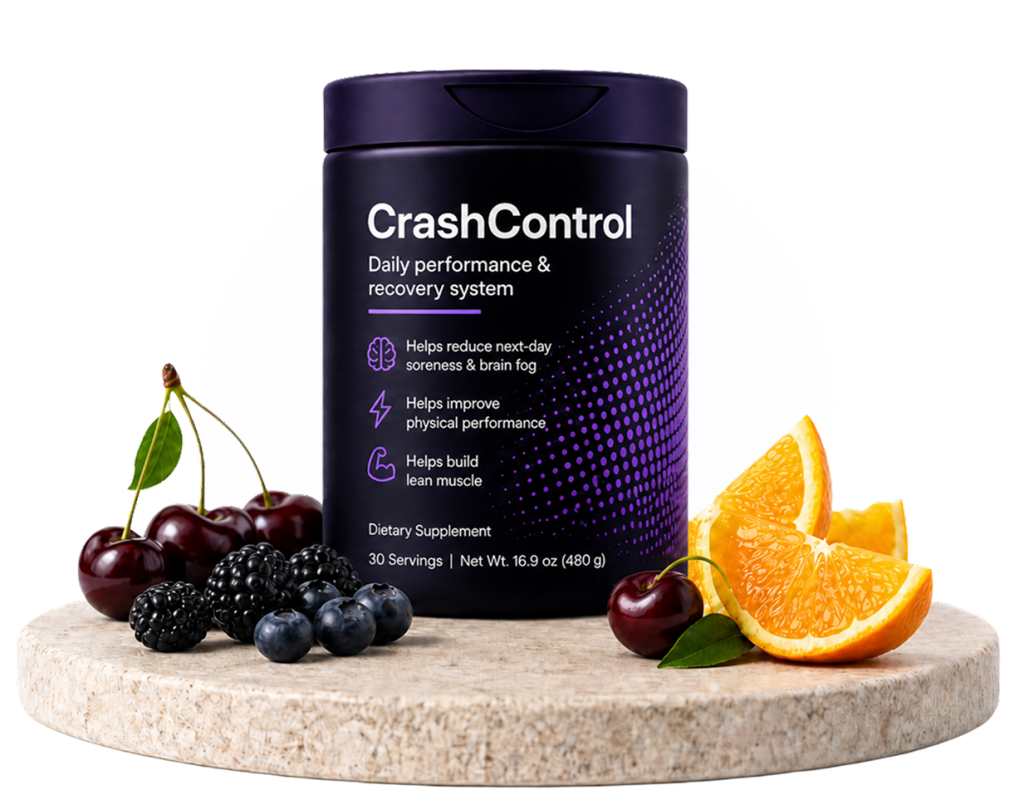
You can keep pushing through soreness, fatigue, and brain fog…
Or you can fix the one thing that’s been holding everything back.
Fix recovery, and everything else will start working!
Here’s Exactly How We Built That System
CrashControl isn’t built around one “hero” ingredient. That’s how most supplements become incomplete.
Instead, every ingredient was chosen because it supports a specific part of the performance and recovery chain.
– Some help you perform better during training
– Some help your body recover after training
– Some help the whole system work more consistently day after day
Together, they cover the pieces most people are missing when they rely on a random stack of bottles.
8 ingredients. Clinically effective dosages. One daily system.
#1 Micronized Creatine (5g) — the strength and performance foundation
Creatine is one of the most researched and consistently proven performance ingredients in sports nutrition.
We’re talking about decades of research, including over 167+ studies and 19+ meta-analyses.
It helps your muscles produce energy during hard training, which supports:
– strength
– power output
– lean muscle growth
– better performance across repeated sessions.
The International Society of Sports Nutrition calls creatine “the most effective ergogenic nutritional supplement available for increasing high-intensity exercise capacity and lean body mass.” [8]
A 2024 meta-analysis published in the reputable Journal of Strength and Conditioning Research found that: “Creatine supplementation combined with resistance training increased lean body mass by an additional 1.14 kg compared with placebo.” [9]
Another 2024 meta-analysis combining data from China, New Zealand, Canada, and Spain found that: “Creatine supplementation combined with resistance training significantly improves upper-body muscle strength by 4.43 kg and lower-body muscle strength by 11.35 kg compared with resistance training alone.” [10]
And after decades of research, there is still “no scientific evidence that the short- or long-term use of creatine monohydrate has any detrimental effects on otherwise healthy individuals.” [8]
So if it works this well, why doesn’t everyone take it?
Because most people try it once, have a bad experience, and never touch it again. The problem is not creatine – the problem is how people take it.
Most bad experiences come from three things:
1. Poor mixability, which can create gritty texture and stomach irritation
2. High loading doses, usually 10-20g/day, which can overwhelm digestion
3. Poor hydration, because creatine pulls water into muscles and fluid balance matters
That’s exactly what we fixed
– Micronized for daily use: We use micronized creatine monohydrate, processed into smaller particles to improve mixability and make daily use easier for many people.
– Correct daily dose (5g): We don’t underdose it. We don’t overload it. We use a clinically effective daily dose that falls within the range used in most studies.
– Built for consistency: Most people stop using creatine because it feels heavy, gritty, or uncomfortable. CrashControl makes it easier to take consistently, and consistency is what makes creatine work long-term.
Doesn’t creatine hurt your kidneys?
No. In healthy individuals, creatine has not been shown to damage kidney function.
This has been repeatedly studied and consistently disproven in healthy individuals, including the recent 2025 systematic review and meta-analysis of studies from 2000 to 2025 published in BMC Nephrology that concluded: “Creatine supplementation does not adversely affect kidney function.” [11]
This concern usually comes from confusion around a marker called creatinine.
When you take creatine, your body naturally produces more creatinine, and that can show up on blood tests. But higher creatinine does not automatically mean kidney damage. It can simply reflect higher creatine turnover in the body.
Important note: People with pre-existing kidney disease should always consult a physician before using creatine. And if you have any diagnosed medical condition, you should speak with your healthcare provider before introducing any supplement into your diet.
Does creatine cause hair loss?
No. This is one of the most common myths around creatine, and one of the most misunderstood.
The concern comes from a small 2009 study on rugby players that found creatine increased levels of a hormone called DHT, or dihydrotestosterone.
And DHT is associated with male pattern hair loss.
But the study only measured hormone levels. It did not measure actual hair loss. Also, the results have not been consistently replicated in later studies.
A more recent clinical study published in April 2025 found “no significant differences in DHT levels, DHT-to-testosterone ratio, or hair growth parameters between the creatine and placebo groups.”[12]
It is also important to understand that hair loss is not primarily influenced by DHT levels alone. It is influenced by:
– genetics
– hormone sensitivity (not just levels)
– overall health
Even if DHT fluctuates slightly, that does not automatically translate into hair loss.
Will creatine make you feel “bloated”?
For most people, no. But this is one of the most commonly reported issues with creatine, so it’s worth explaining properly.
There are two very different things people mix up:
1. Water inside muscle cells (this is good)
Creatine increases intracellular water, meaning water is pulled into your muscle cells.
This is part of how it works:
– supports strength and performance
– contributes to muscle fullness
– improves training output
This is NOT bloating. It’s part of the benefit.
2 Digestive discomfort (this is the real issue)
This is what people usually mean when they say “bloating.”
And it typically comes from:
– poorly dissolved creatine (gritty particles irritating the gut)
– large doses (especially loading phases of 10–20g/day)
– taking it without enough fluid
Why our formula minimizes that risk
– Better mixability: Micronized creatine means fewer gritty, undissolved particles.
– Controlled dose: 5g avoids digestive overload for most people.
– Electrolytes included: Electrolytes help support proper fluid balance.
Bottom line:
– Creatine itself does not cause “bloating” in the traditional sense
– Most issues come from form, dose, or poor hydration
– When used properly, most people tolerate it very well
Do you need to cycle creatine?
No. Creatine isn’t a steroid and doesn’t impact your endocrine system, so it doesn’t need to be cycled.
In fact, cycling creatine can be counterproductive. Each time you stop taking it for an extended period and then resume, you have to wait for creatine to build back up in your muscles again.
Will I feel the effect instantly?
No. Creatine is not a stimulant. You won’t feel a sudden kick.
It builds up over time with consistent use.
Most people start noticing real benefits after 7-14 days of daily intake.
Does creatine require a “loading phase?”
A loading phase is not required for any type of creatine.
Loading usually means taking 10-20g per day for 5-7 days. This helps saturate muscle creatine stores faster.
But here’s the key: It does not improve long-term results.
Studies comparing loading vs steady intake show:
– both approaches reach similar muscle creatine levels
– loading just gets you there sooner
The problem with loading is that it increases the chance of:
– digestive discomfort
– water imbalance
– unnecessary stress on your system
With 5g a day, you still reach full saturation, just over a slightly longer period.
The key to getting the most from creatine is taking it consistently, not loading 20g today and dropping it for a week.
#2 Electrolytes — the foundation of hydration, performance, and recovery
Electrolytes are one of the most misunderstood parts of recovery.
Most people think they only matter if you’re sweating a lot, running marathons, or working out in extreme heat.
But that’s not how your body works.
Electrolytes, mainly sodium, potassium, and chloride, are essential for basic functions like:
– maintaining fluid balance
– supporting muscle contractions
– transmitting nerve signals
– regulating energy and performance
Every time you train, your body uses and shifts electrolytes. And when you sweat, you lose even more.
What happens when electrolytes are not properly restored?
Even mild imbalances can lead to:
– reduced physical performance
– quicker fatigue
– decreased strength output
– brain fog and reduced mental clarity
– slower recovery
This is not dramatic. You won’t “crash.”
But you will feel:
– slightly off
– slightly weaker
– slightly less sharp
And that compounds over time.
Can’t you just drink more water?
Hydration is not just about water.
A review published in the Journal of the International Society of Sports Nutrition notes that: “Plain water ingestion alone may not be sufficient to restore fluid balance… sodium ingestion helps retain ingested fluids and maintain hydration status.” [13]
Without electrolytes, especially sodium, your body cannot properly retain and use that fluid.
Why most electrolyte products don’t solve this
Most products on the market are built for taste and marketing, not for how your body actually works.
They tend to:
– underdose key electrolytes (so you feel like you’re hydrated, but nothing changes)
– swing to the other extreme and push very high sodium, often around 1,000mg per serving
That second category has become especially popular recently.
And while high sodium intake can be useful in specific situations, like long endurance sessions, extreme sweating, or heat exposure, it is not always the best fit for everyday use.
Using that level of sodium daily may be unnecessary for many people, especially if their diet already includes normal sodium intake.
Why electrolytes are part of this system
Electrolytes are not optional.
They are one of the core pieces of the recovery chain.
Without proper hydration at the cellular level:
– muscle function declines
– energy production becomes less efficient
– recovery slows down
Which means even if everything else is dialed in, you still won’t feel fully recovered.
We include electrolytes in amounts that are actually meaningful:
– Sodium — 300 mg
– Potassium — 200 mg
– Chloride — 250 mg
The goal is simple:
– help replace what you lose through training
– support fluid balance inside your cells
– help your body maintain stable performance
So the rest of the system can do its job properly.
“I already get enough salt from food. Why would I need this?”
You probably do get some sodium from food.
But recovery and performance aren’t just about getting enough of one thing.
They depend on a balance between electrolytes, especially sodium and potassium.
Many modern diets are skewed toward sodium while being relatively low in potassium.
That imbalance can affect how your body manages hydration, muscle function, and energy.
On top of that, many people assume they’re covering this with sports drinks.
In reality, most sports drinks contain relatively small amounts of electrolytes, often not enough to meaningfully support hydration or recovery.
So the issue isn’t that you’re getting nothing. It’s that you may not be getting the right balance, in meaningful amounts, consistently.
That’s exactly what this system is designed to help with, without you having to track, measure, or guess.
“Aren’t electrolytes only for endurance athletes?”
That’s where most people hear about them. But that’s not where they matter.
Electrolytes are involved in every muscle contraction and every nerve signal in your body.
That includes:
– lifting weights
– strength training
– short, intense workouts
– even moderate sessions a few times a week
You don’t need to be running a marathon to lose electrolytes. And you don’t need to be depleted to feel the effects.
Even small imbalances can show up as:
– lower strength
– faster fatigue
– feeling “off” the next day
This isn’t about survival performance. It’s about how you feel and perform daily.
“Electrolytes make me bloated or hold water. Won’t this do the same?”
That usually comes from two things:
– very high sodium doses
– poor balance between sodium and potassium
Some popular products push sodium extremely high, which can make you feel heavy or “puffy,” especially if you’re using them daily.
That’s exactly what we avoided here.
This formula uses:
– a moderate amount of sodium
– paired with potassium and chloride
– in a balanced ratio designed for daily use
So instead of feeling bloated, you will get the opposite:
– better fluid balance
– better muscle function
– and a more stable, “normal” feeling the next day
#3 Taurine (2g) — cellular hydration and nervous system stability
Taurine is one of the most misunderstood ingredients in sports nutrition.
Most people recognize the name from energy drinks, which is exactly why they misunderstand what it actually does.
Taurine is not a stimulant. It doesn’t “give you energy” like caffeine.
In fact, in energy drinks, it’s included to smooth out the effects of extreme caffeine dosages.
But what it actually does is much more important for performance and recovery.
What does it actually do?
Taurine helps regulate fluid balance inside your cells, not just in your bloodstream, but inside the muscle cells themselves.
This matters because:
– properly hydrated cells perform better
– muscle contractions are more efficient
– fatigue builds up slower
Taurine also plays a key role in:
– supporting nervous system function
– helping regulate muscle contractions
– protecting cells from exercise-induced stress
In simple terms, it helps your body stay stable under stress, instead of breaking down faster.
And this isn’t theory. It has been studied across multiple trials:
A 2022 review of 19 studies published in the Journal of the International Society of Sports Nutrition found that taurine supplementation “may improve aerobic performance (TTE), anaerobic performance (strength, power), recovery (DOMS), and a decrease in metabolic markers (creatine kinase, lactate, inorganic phosphate).” [14]
A 2008 study published in the Journal of Neuroscience found that taurine “reduced the excitability of thalamocortical relay neurons…” [15]. In plain English, taurine may help reduce overactive signaling in parts of the brain and nervous system.
That doesn’t mean it makes you sleepy. Taurine is not a sedative.
It doesn’t knock you out or slow you down.
It helps your system return to baseline faster after stress.
Which matters after training, when your body is in a heightened, stimulated state.
What you will (and won’t) feel
Taurine is not something you “feel” instantly.
What you may notice over time:
– more stable performance
– less mental and physical fatigue
– smoother recovery between sessions
Why it’s part of this system
Taurine supports two critical parts of recovery:
– cellular hydration (working together with electrolytes)
– nervous system stability
Without those, you get:
– faster fatigue
– less efficient muscle function
– worse next-day performance
It’s not flashy. But it’s one of the pieces that makes everything else work better.
And without it, you’re leaving performance and recovery on the table.
“Will taurine make me sleepy or slow me down?”
No. Taurine is not a sedative.
It doesn’t make you drowsy or reduce your energy.
What it does is help your nervous system stay balanced.
That can feel like:
– less internal tension
– more stable energy
– clearer thinking
Some people describe it as feeling “calmer.”
Not tired. Just more in control.
“Why do some people take 3–6 grams? Do I need that much?”
You’ll see a wide range of doses online, from 500mg to 6g or more.
Higher doses are sometimes used in specific contexts or studies.
But more is not always better.
What matters is:
– using an effective dose
– using it consistently
– combining it with the right supporting ingredients
In this system, taurine is dosed at 2g to work as part of a complete recovery stack, not as a standalone megadose.
“I tried taurine and didn’t feel anything. Does it even work?”
That’s actually very common and expected.
Taurine is not a stimulant. You’re not supposed to “feel” it right away like caffeine or pre-workouts.
Its effects are subtle, cumulative, and system-level.
It helps your body:
– handle stress better
– recover more efficiently
– perform more consistently
Which shows up over time as:
– less fatigue
– smoother recovery
– better next-day performance
Not a spike. A difference in how you feel overall.
Why is Taurine included in energy drinks?
Taurine got popular because it was added to energy drinks.
That created a false association: “Energy drink = stimulation → taurine = stimulant.”
But taurine is often added to those products for the opposite reason – to help smooth out the effects of stimulants on the nervous system.
Not to increase energy itself.
So when people say, “I tried taurine and didn’t feel anything.” That’s actually expected. Taurine is not something you “feel” right away.
It’s something that helps you:
– perform more consistently
– recover more smoothly
– avoid that “wired → drained” cycle
#4 Glycine (2.5g) — deeper recovery and nervous system reset
Glycine is one of the key amino acids your body relies on to recover after stress.
It supports:
– tissue repair
– collagen production (joints, tendons, connective tissue)
– nervous system regulation
– sleep quality and recovery
One of its most important roles is helping your body shift out of “stress mode” after training.
Because training is not just physical. It is also a stress signal your body has to recover from afterward.
And the benefits aren’t theoretical. Glycine has been tested in controlled human studies:
A 2012 study on sleep-restricted healthy volunteers published in Frontiers in Neurology found: “In subjects given glycine, the VAS data showed a significant reduction in fatigue and a tendency toward reduced sleepiness.” [16] In simple terms, people felt less fatigued and more functional the next day.
Another 2012 study published in the Journal of Pharmacological Sciences found that “…orally administered glycine acts on NMDARs in the SCN and decreases core body temperature, resulting in an improvement in sleep quality.” [17] In simple terms, glycine helped the body shift into a state that supports better sleep and recovery.
Why Glycine matters for recovery
Most people think that only muscles need recovery.
But real recovery also includes:
– joints and connective tissue
– nervous system
– sleep quality
If even one of those is under-supported, recovery slows down.
Glycine helps support all of them at once.
What you will (and won’t) feel
Glycine is not a stimulant. You won’t feel a “boost.”
Some people notice:
– better sleep quality
– feeling more recovered
– less next-day fatigue
Others don’t feel anything directly, but still benefit over time.
Just like taurine, it works in the background. And the difference shows up in how you feel the next day.
“Can’t I just get enough glycine from food?”
In theory — yes. In practice, intake is usually inconsistent.
Glycine is found in protein-rich foods, especially those that contain connective tissue like skin, cartilage, and collagen.
But most modern diets are built around:
– lean meats
– muscle cuts
– processed protein sources
Which are relatively lower in glycine compared to traditional “nose-to-tail” eating.
To reach amounts commonly used in studies (~3g), you would need to consistently eat large portions of collagen-rich foods, not just protein overall.
That’s possible. But hard to maintain every day, especially if you have a busy schedule, travel, or don’t specifically plan your meals around it.
This system removes that guesswork and gives you a consistent baseline intake every day.
“Does glycine make you sleepy?”
Not in the way people usually think.
Glycine is not a sedative. It doesn’t “knock you out.”
What it does is help your body shift into a state that supports recovery, which includes better sleep quality.
That doesn’t mean it forces sleep. It means it helps your body recover more effectively during sleep.
For most people, that shows up as:
– falling asleep a bit easier
– sleeping more consistently
– feeling more refreshed the next day
Not feeling drowsy during the day.
“Is glycine safe to take every day?”
Glycine is a naturally occurring amino acid.
It’s:
– found in everyday foods
– produced by your body
– used in multiple essential functions (including collagen synthesis and nervous system signaling)
Human studies using glycine for sleep and recovery have used daily intake protocols. No serious adverse effects were reported in these controlled settings.
As with any supplement, it’s meant for healthy individuals, used as part of a balanced routine.
“I’ve heard glycine can make some people feel stimulated or anxious. Is that true?”
For most people, glycine has a calming effect. It helps the body shift out of a “stressed” state and supports better sleep and recovery.
However, individual responses can vary. A small percentage of people report the opposite effect:
– feeling more alert
– mild restlessness
– difficulty falling asleep
This is uncommon, but it does happen.
There are a couple of likely reasons:
– differences in how the nervous system responds to glycine
– overall neurotransmitter balance
– and, in some cases, low magnesium levels, which can affect how calming signals are processed
If you’ve tried glycine before and didn’t respond well to it, your experience may be different, and it’s something to be aware of.
#5 Rhodiola Rosea Extract (200mg) - fatigue resistance and daily function
Rhodiola Rosea is one of the few adaptogens (plant extracts that help support your body’s response to stress) that actually fit this system.
Not because it gives you a stimulant “kick.” And not because we wanted to throw a trendy stress ingredient into the formula.
It belongs here because the crash after training is not always just soreness.
Sometimes it shows up as:
– low drive
– afternoon fatigue
– brain fog
– feeling drained before your next workout
– needing more coffee just to feel normal
That is the part most recovery products ignore.
They focus on muscles. But you still have to work, think, focus, make decisions, talk to people, and get through the rest of your day.
So you usually end up trying to patch it with more coffee, which pushes your energy up quickly, but can leave you paying for it later.
Rhodiola works differently.
It helps support fatigue resistance, mental performance, and stress resilience without forcing a hard stimulant spike.
And the research behind it is promising:
New research published in Nutrients in November 2025 found that short-term Rhodiola Rosea supplementation “causes dose-dependent improvements in resistance exercise performance… and produces significant nootropic effects on cognitive function.“ [18]
A clinical study published in Planta Medica in 2008 found that standardized Rhodiola Rosea extract had an anti-fatigue effect in people with stress-related fatigue. The authors concluded that Rhodiola Rosea extract “exerts an anti-fatigue effect that increases mental performance, particularly the ability to concentrate and decreases cortisol response to awakening stress.” [19]
What you will (and won’t) feel
Rhodiola is not a pre-workout. You should not expect tingles, a rush, or a sudden caffeine-like kick.
What some people may notice is:
– less afternoon drag
– better mental clarity
– more stable energy
– feeling less drained by the day
– better ability to stay functional after training
For others, the effect may be more subtle. That’s normal.
Rhodiola works best as part of the full system, alongside ingredients that support hydration, recovery, muscle repair, and performance.
That’s why it belongs in CrashControl. It supports the part of the crash that happens outside the gym.
Is Rhodiola a stimulant?
Not like caffeine.
Rhodiola is usually classified as an adaptogen, not a stimulant.
That means it helps support the body’s response to physical and mental stress instead of forcing a hard energy spike.
That said, some people can feel Rhodiola as mildly energizing, which is why it’s better to take it earlier in the day and not before bedtime.
Who should be careful with Rhodiola?
If you take prescription medication or have a diagnosed medical condition, talk to your healthcare provider first.
This is especially important if you take medication for:
– blood pressure
– blood sugar
– mood or depression
– immune conditions
– hormone replacement therapy
Can I still drink coffee with it?
Yes, but don’t add more caffeine than usual until you know how CrashControl feels for you.
CrashControl does not contain caffeine, but Rhodiola can feel mildly energizing for some people.
If you feel wired, restless, or notice worse sleep, take CrashControl earlier in the day or reduce caffeine.
#6 Betaine (TMG) (2.5g) — strength, power, and performance under load
Betaine is one of those ingredients most people overlook.
Not because it doesn’t work. But because it’s not as widely talked about as creatine, caffeine, or electrolytes.
And that’s a mistake.
Because betaine is one of the few ingredients shown to directly support strength and performance in training.
What does betaine actually do?
Betaine supports performance in two key ways:
1. It helps your muscles produce more force: It plays a role in cellular hydration and energy-related processes that support muscle function. In simple terms, it helps your muscles work harder and sustain output longer.
2. It supports strength and lean mass over time: Unlike stimulants that just “push” you temporarily, betaine supports the actual output your body can produce. That’s what leads to: more reps, more weight and better training sessions
These benefits are not just anecdotal.
A 2009 study published in the Journal of the International Society of Sports Nutrition found that “two-weeks of betaine supplementation in active, college males appeared to improve muscle endurance of the squat exercise, and increase the quality of repetitions performed.” [20]
A 2013 study on betaine effects on trained men published in the same journal concluded that “six-weeks of betaine supplementation improved body composition, arm size, bench press work capacity…” [21]
Why this matters for recovery?
Recovery doesn’t start after your workout.
It starts with what you did during your workout.
Every workout creates a signal your body has to respond to:
– how much weight you lifted
– how many reps you completed
– how much total work your muscles handled
That signal determines how your body adapts.
If your output is low, the signal is weak and results are limited.
If your output is higher, the signal is stronger and your body has a reason to adapt.
That’s where betaine comes in.
By helping support output, it may help you:
– lift slightly heavier
– push a few more reps
– maintain performance across sets
Not in a dramatic, stimulant-driven way. In a consistent, repeatable way.
And that creates a stronger training stimulus.
Now here’s the key: A stronger stimulus only leads to better results if your body can recover from it.
That’s why betaine works best as part of a system:
– creatine supports strength and cellular energy
– electrolytes and taurine support hydration and muscle function
– glycine supports recovery and nervous system reset
– Rhodiola supports fatigue resistance and daily function
– LCLT and tart cherry support soreness and muscle recovery
So instead of: training hard, feeling wrecked, then underperforming next session
You get: better output, proper recovery, then better output again
“Isn’t betaine something I already get from food?”
Yes, but not in amounts that consistently impact performance.
Betaine is found in foods like:
– beets
– spinach
– whole grains
But typical daily intake from food is estimated to be around 100-400 mg per day, depending on diet.
Most studies showing performance benefits use doses around 2.5g per day, which is much higher than what most people get from food consistently.
So while you do get some betaine naturally, it’s usually not enough to produce measurable changes in strength, performance, or body composition.
This system gives you a reliable daily baseline without needing to plan your entire diet around it.
“I’ve heard betaine affects homocysteine — is that a bad thing?”
This is actually one of the benefits, not a risk.
Betaine plays a role in methylation, where it helps convert homocysteine into methionine.
Elevated homocysteine levels are associated with cardiovascular risk, so supporting this pathway is generally considered beneficial.
That’s why betaine is sometimes used in clinical settings for people with impaired methylation.
For healthy individuals, this is simply part of normal physiology, not something harmful or dangerous.
“Will I feel anything right after I take betaine?”
Probably not, and that’s a good thing.
Betaine is not a stimulant.
It doesn’t give you a “kick,” a pump, or tingling like pre-workouts with beta-alanine do.
What it does is improve your actual output over time, which may show up as:
– slightly better performance in workouts
– more consistent strength
– improved work capacity
It’s the kind of ingredient you notice in your numbers, not in a sudden feeling.
“Can betaine (TMG) cause anxiety or overstimulation?”
Betaine is a methyl donor. That’s part of how it works in the body.
In some cases, usually at higher doses or in more sensitive individuals, this can lead to:
– irritability
– restlessness
– or anxiety-like symptoms
But this effect is dose-dependent. Most of the reports you see online are linked to:
– higher intakes (often 3g+ on its own)
– stacking it with other supplements
– changes in diet and training at the same time
In this formula, betaine is used at 2.5g, and it’s not taken in isolation.
It’s balanced with ingredients like glycine and taurine, which support nervous system stability and help smooth out potential overstimulation.
For most people, betaine supports performance without noticeable side effects.
But if you know you’re sensitive to supplements that affect mood or energy, it’s something to be aware of.
#7 L-Carnitine L-Tartrate (2g) — recovery, soreness, and muscle repair
L-Carnitine is often misunderstood. Most people think of it as a “fat-burning” supplement.
That’s not why it’s here.
The form used in CrashControl, L-Carnitine L-Tartrate (LCLT), is included for one reason: to support faster recovery from training
What does LCLT actually do?
LCLT supports recovery in a few key ways:
– helps reduce markers of muscle damage from training
– helps decrease exercise-induced soreness
– supports muscle repair processes
– supports recovery between sessions
In simple terms, it helps your body bounce back faster after hard workouts.
And these benefits have been shown in human studies:
A 2002 study published in the American Journal of Physiology, Endocrinology and Metabolism concluded: “LCLT supplementation is effective in assisting recovery from high-repetition squat exercise.” [22]
A 2010 study published in Metabolism: Clinical and Experimental found that LCLT supplementation “can reduce chemical damage to tissues after exercise and optimize the processes of muscle tissue repair and remodeling.” [23]
A 2006 study published in Medicine and Science in Sports and Exercise found that “LCLT supplementation upregulated androgen receptor content, which may promote recovery from resistance exercise.” [24] This matters because androgen receptors play a role in how your body responds to training, including muscle growth and adaptation.
This is not about doing more. It’s about recovering from what you already do.
Why this matters for recovery?
Training creates stress and damage. That’s necessary. It’s part of what triggers adaptation.
But if your body can’t recover efficiently, that damage carries forward:
– soreness that lingers longer than it should
– workouts that feel harder than expected
– performance slowly dropping instead of improving
LCLT helps reduce that carryover.
So instead of: training hard, feeling sore, then compromising your next session
You get: training, better recovery, then a body that is more ready to perform again
What you will (and won’t) feel
LCLT is not a stimulant. You won’t feel an immediate effect.
What you may notice over time:
– less soreness after workouts
– faster recovery between sessions
– more consistent performance
It works quietly. But it shows up in how you feel the next day.
“Will LCLT raise my cholesterol?”
There are occasional anecdotal reports online of changes in cholesterol markers, but this is not consistently shown in controlled human studies using LCLT for performance and recovery.
Factors like overall diet, body composition, and activity level have a much larger impact on cholesterol than any single ingredient.
If you already monitor your cholesterol, it’s reasonable to continue doing so regardless of supplementation.
“Is this just a fat-burning ingredient?”
No. That’s the most common misconception.
While L-carnitine is often marketed for fat loss, the form used here, L-Carnitine L-Tartrate, is included for its recovery and muscle-support benefits.
Not fat burning. Its role in this system is simple: Help your body recover better so you can perform again.
#8 Tart Cherry Extract (500mg) — soreness, inflammation, and faster recovery
Tart Cherry is one of the few natural ingredients consistently studied for recovery.
Not by boosting performance directly.
But by helping your body recover more smoothly after hard training.
We use concentrated extract of Montgomery tart cherries, the specific variety most commonly used in recovery research.
What does Tart Cherry actually do?
Tart Cherry is rich in compounds called polyphenols and anthocyanins.
These compounds help support your body’s response to exercise-induced stress.
Which may help with:
– reduced muscle soreness
– better recovery between sessions
– less next-day stiffness
– faster return to normal movement after hard training
In simple terms, it helps you feel less beat up after you train.
And these effects have been demonstrated in human studies:
A 2021 meta-analysis of 14 studies published in the International Journal of Sport Nutrition and Exercise Metabolism concluded: “results indicate that the consumption of a Tart Cherry supplement can aid aspects of recovery from strenuous exercise.” [25] In other words, across multiple studies, tart cherry consistently showed measurable recovery benefits.
A 2016 study published in the Nutrients Journal found that “Montgomery Cherry supplementation has been shown to accelerate the recovery of a number of functional performance measures following prolonged intermittent sprint activity” [26]. Meaning, subjects recovered faster and regained performance more quickly after demanding exercise.
Why this matters for recovery?
You don’t just feel soreness. You carry it into the next day.
That’s when you notice:
– movements feel stiff
– warm-ups take longer
– strength isn’t quite there
– your next session feels harder than it should
Tart Cherry helps reduce that carryover.
So instead of: training hard, feeling sore, then dragging through your next session.
You get: training, smoother recovery, then a body that feels more ready to move again.
What you will (and won’t) feel
Tart Cherry is not a stimulant. You won’t feel anything right after taking it.
What you may notice:
– less soreness the next day
– easier movement when you start your next workout
– smoother recovery between sessions
– faster return to normal after hard training
It’s not about how you feel right after taking it. It’s about how you feel after your workouts.
Why it’s part of this system
Tart Cherry supports one specific part of recovery: helping reduce the soreness and stiffness that can carry into the next day.
It works together with:
– LCLT for muscle damage and repair support
– glycine for recovery and sleep quality
– taurine for cellular stability
– electrolytes for hydration
– Rhodiola for fatigue resistance and daily function
– creatine and betaine for performance output
So instead of relying on one pathway, you’re supporting multiple layers of recovery at once.
“Can’t I just drink tart cherry juice?”
You can, but it’s not very practical.
Most studies showing recovery benefits use concentrated doses, which would require drinking large amounts of juice daily.
That comes with:
– a lot of sugar
– extra calories
– inconsistent dosing
We use a concentrated extract, so you get the same active compounds in a controlled amount without the sugar and guesswork.
“Is this just for endurance athletes?”
No. Tart Cherry has been studied in both:
– endurance exercise (running, cycling)
– resistance training (weights, sprint work)
The benefit is not tied to the type of training. It’s tied to how your body recovers after stress.
If your workouts create soreness or fatigue, this applies.
“Will I feel anything when I take it?”
Not immediately. Tart Cherry is not a stimulant. You won’t feel a “boost.”
What most people notice is:
– less soreness the next day
– easier movement when they start training
– smoother recovery between sessions
It’s not about how you feel right after taking it. It’s about how you feel after your workouts.
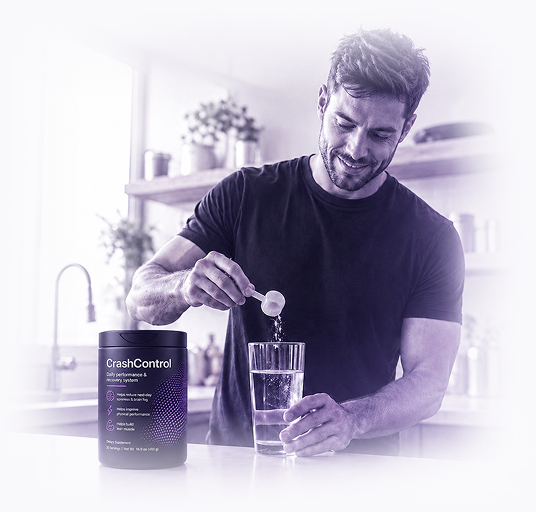
How To Use It
Take one scoop per day with food or shortly after food.
For best results, take CrashControl earlier in the day, ideally with or after breakfast or lunch.
The formula contains micronized creatine monohydrate, which mixes better than regular creatine monohydrate and may feel easier for many people to take daily. But like most supplements, it can still feel heavier for some people on an empty stomach.
The formula also contains Rhodiola Rosea, which can feel mildly energizing for some sensitive users. That’s why we recommend taking CrashControl earlier in the day, ideally before 2pm.
What matters most is consistency.
Because the ingredients in this system:
– build up over time
– support ongoing recovery processes
– work best when taken daily
You can miss a day every now and then. We’re all human. The system won’t break immediately.
But to get the best results, take it daily.
What You Can Expect (And When)
You won’t feel a sudden “kick” or tingling the first time you take it.
This system works differently.
Some ingredients may feel subtle early on, especially Rhodiola and electrolytes.
Others, like creatine, LCLT, glycine, and tart cherry, build with consistent use as your body starts recovering more efficiently between sessions.
Week 1
You start noticing the small things
- Slightly less soreness
- Less of that heavy feeling next day
- Less afternoon drag
- More stable energy during the day
Nothing extreme. Just a subtle difference in how you feel.
Week 2
Performance starts to feel more consistent
- Soreness doesn’t linger as long
- Workouts feel more consistent
- Less drop-off between sets
- You feel more put together
You’re still training hard. But it doesn’t feel like it’s carrying over as much.
Week 3+
Your new energy and recovery baseline
- Recovery feels noticeably better
- Performance feels more stable
- Your energy doesn't dip
- Your body feels ready more often
And this is the key shift: You stop thinking about recovery all the time because it’s no longer the thing holding you back.
Could You Build A System That Does This Yourself?
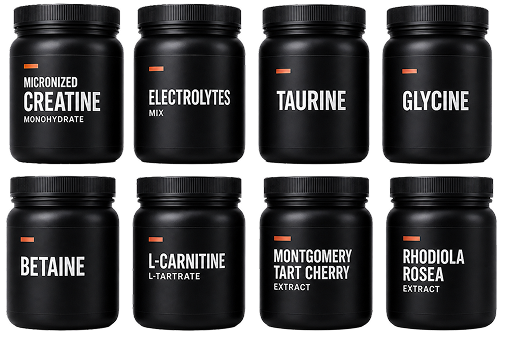
Technically, yes. You could buy all the ingredients separately:
– Micronized creatine monohydrate
– Electrolytes
– Taurine
– Glycine
– Betaine
– L-Carnitine L-Tartrate
– Montgomery tart cherry extract
– Rhodiola Rosea extract
And if you buy decent versions of each one, manufactured in the USA in an FDA-registered facility with batch-level safety testing, you’ll probably spend around $90 per month.
But that’s not the real problem. The real problem is what happens after you buy them…
Now you have:
– 6-8 separate containers
– different serving sizes
– powders and capsules to track
– ingredients running out at different times
– measuring, mixing, and cleaning
– no flavor system or a weird mix of flavors
– no easy routine
And if you miss doses, skip ingredients, or get tired of managing the stack, the system stops being a system.
It turns back into what you most likely already have: random supplements you take when you remember.
CrashControl exists to fix that.
One scoop. One daily routine. Full performance and recovery support without building a supplement cabinet in your kitchen.
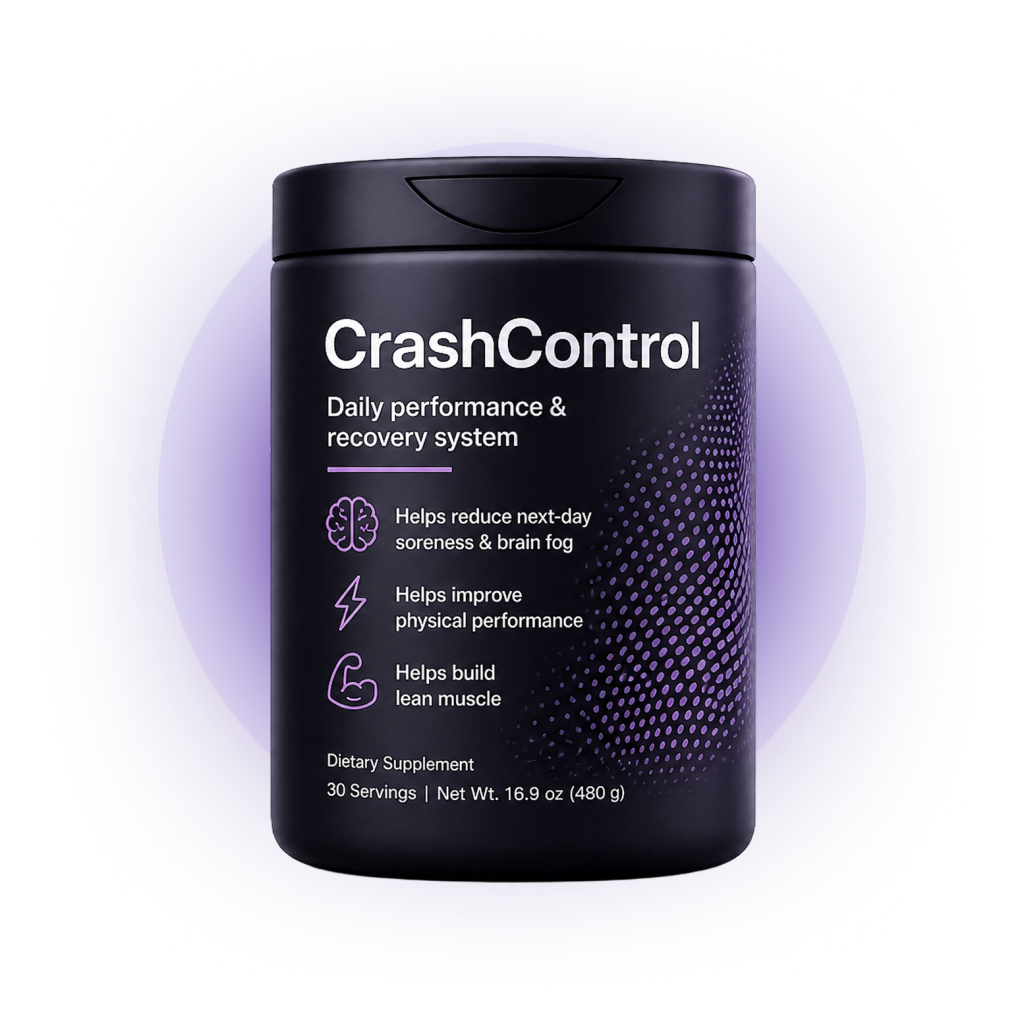
So What Does It Cost To Get All of The Benefits… Without The Hassle?
You’ve seen what it takes to build this yourself.
Now compare that to this – one scoop per day with:
– high-quality ingredients
– proper dosages
– a flavor you actually enjoy
– manufactured in the USA in an FDA-registered facility following cGMP practices.
We plan on pricing it:
– $59.95/month (23% off) for 3-month subscriptions (billed every 90 days)
– $69.95/month (12% off) for monthly subscriptions (billed every 30 days)
– $79.95 for a one-time purchase
But for early access, you can lock in a special price of just $49.95 (both from one-time purchases and monthly subscriptions).
That’s 38% off one-time purchase price… and the price will never change for you. Cancel or pause any time.
All you have to do to lock that price is sign up for the pre-launch list below.
Once we launch the product (around mid-July 2026), you will receive a special purchase link with your early-access price.
Sign up for the pre-launch list now:
Please note that the first production run will be limited, and priority will be given to pre-launch list subscribers based on the date they subscribed.
So if you want the early-access price, reserve your spot now.
What If This System Doesn’t Work For You?
We’re not going to promise instant results.
CrashControl is a daily system, and it takes consistent use to feel the difference.
What we will do instead is… make it risk-free for you to try.
Get yours and use it every day for 30 days.
In these 30 days, you must notice:
– better performance in your workouts
– better recovery between sessions
– less next-day soreness
– generally feeling more “put together” after training
If you don’t notice these changes, the system is not doing its job. Just email us, and we’ll give you a full refund.
This system must work, or you pay nothing.
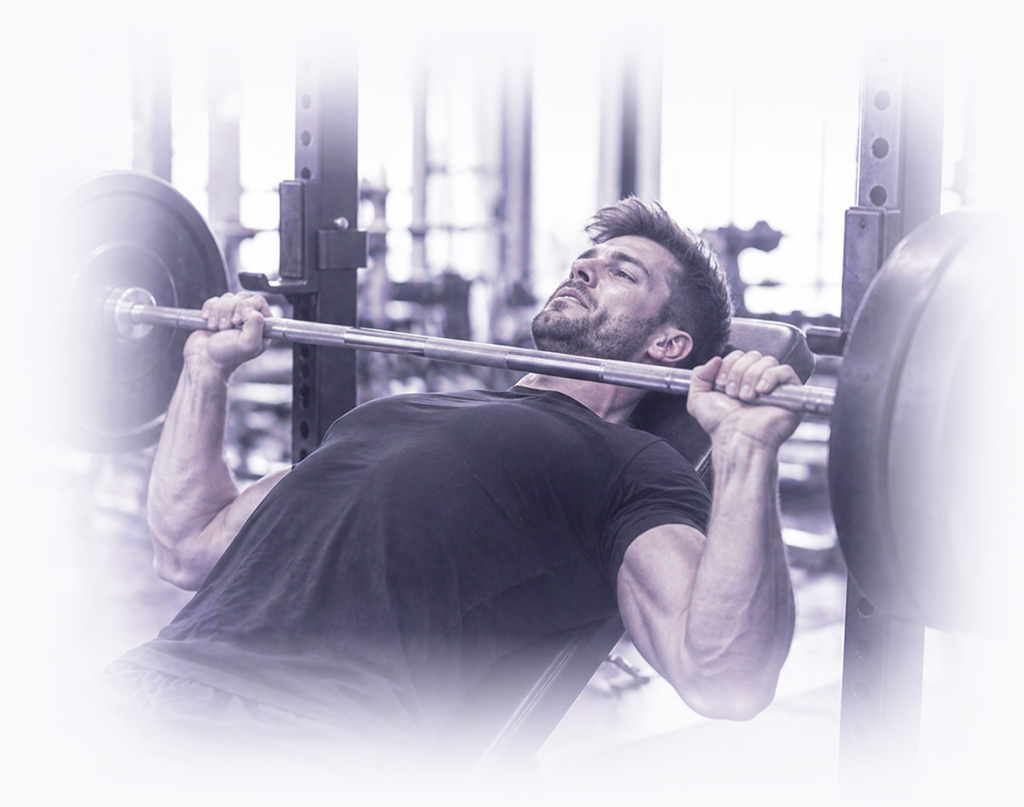
You don't need more motivation. You don't need another training program. You don't need to “push harder.”
You need to stop carrying yesterday’s fatigue into today.
Because that’s what’s actually holding you back.
Right now, you’re stuck in a loop:
– you train hard
– you feel it the next day
– you go into your next session at 80%
– and you repeat it… week after week.
And over time, that turns into:
– slower progress than you should be making
– inconsistent performance
– constant fatigue that never fully goes away
– that feeling like you’re always one step behind
You’re putting in the work. But your body never fully catches up.
Now imagine this instead:
It’s 2-3 weeks from now.
You’re finishing your workout and instead of thinking “this is going to hurt tomorrow…”, you’re not even worried about it.
Because you already know what the next day will feel like.
You wake up.
Your body feels normal. Not wrecked. Not stiff.
You move easily. You don’t have to warm up just to function.
But more importantly, your head is clear.
You’re not dragging through the day. You’re not fighting brain fog. You’re not trying to “push through” work with half your energy missing.
And when it’s time to train again, your strength is there. Your body is ready.
You perform better, not worse, than your last session.
That’s what happens when recovery stops being the problem.
You can keep pushing through soreness, fatigue and brain fog…
Or you can fix the one thing that’s been holding everything back.
And you can start today:
Fix recovery, and everything else will start working!
References:
[1] – Effect of Branched-Chain Amino Acid Supplementation on Recovery Following Acute Eccentric Exercise – https://www.mdpi.com/2072-6643/10/10/1389
[2] – Effect of glutamine supplementation combined with resistance training in young adults: https://pubmed.ncbi.nlm.nih.gov/11822473/
[3] – The Effects Of Glutamine On Muscle Strength And Body Composition: https://journals.lww.com/acsm-msse/fulltext/2005/05001/the_effects_of_glutamine_on_muscle_strength_and.240.aspx
[4] – The effects of 12 weeks of beta-hydroxy-beta-methylbutyrate free acid supplementation on muscle mass, strength, and power in resistance-trained individuals: a randomized, double-blind, placebo-controlled study: https://pmc.ncbi.nlm.nih.gov/articles/PMC4019830/
[5] – Effects of Nine Weeks of β-Hydroxy-β- Methylbutyrate Supplementation on Strength and Body Composition in Resistance Trained Men: https://journals.lww.com/nsca-jscr/fulltext/2009/05000/effects_of_nine_weeks_of___hydroxy___.18.aspx
[6] – Supplementation with the Leucine Metabolite β-hydroxy-β-methylbutyrate (HMB) does not Improve Resistance Exercise-Induced Changes in Body Composition or Strength in Young Subjects: A Systematic Review and Meta-Analysis: https://www.mdpi.com/2072-6643/12/5/1523
[7] – International Society of Sports Nutrition Position stand: Beta-Alanine: https://link.springer.com/article/10.1186/s12970-015-0090-y
[8] – International Society of Sports Nutrition position stand: creatine supplementation and exercise: https://pmc.ncbi.nlm.nih.gov/articles/PMC2048496/
[9] – The Journal Of Strength And Conditioning Research: The Effect of Creatine Supplementation on Resistance Training–Based Changes to Body Composition: A Systematic Review and Meta-analysis: https://journals.lww.com/nsca-jscr/fulltext/2024/10000/the_effect_of_creatine_supplementation_on.16.aspx
[10] – Effects of Creatine Supplementation and Resistance Training on Muscle Strength Gains in Adults <50 Years of Age: A Systematic Review and Meta-Analysis: https://www.mdpi.com/2072-6643/16/21/3665
[11] – Effect of creatine supplementation on kidney function: a systematic review and meta-analysis: https://link.springer.com/content/pdf/10.1186/s12882-025-04558-6.pdf
[12] – Does creatine cause hair loss? A 12-week randomized controlled trial: https://www.tandfonline.com/doi/full/10.1080/15502783.2025.2495229
[13] – International Society of Sports Nutrition Position Stand: nutritional considerations for single-stage ultra-marathon training and racing: https://pmc.ncbi.nlm.nih.gov/articles/PMC6839090/
[14] – Journal of the International Society of Sports Nutrition: Taurine in sports and exercise: https://www.tandfonline.com/doi/full/10.1186/s12970-021-00438-0
[15] – Journal of Neuroscience: Taurine Is a Potent Activator of Extrasynaptic GABAA Receptors in the Thalamus: https://pmc.ncbi.nlm.nih.gov/articles/PMC6671153/
[16] – Frontiers in Neurology: The effects of glycine on subjective daytime performance in partially sleep-restricted healthy volunteers: https://pubmed.ncbi.nlm.nih.gov/22529837/
[17] – Journal of Pharmacological Sciences: New Therapeutic Strategy for Amino Acid Medicine: Glycine Improves the Quality of Sleep -https://www.sciencedirect.com/science/article/pii/S1347861319305729
[18] – Nutrients Journal: Dose–Response Effects of Short-Term Rhodiola rosea (Golden Root Extract) Supplementation on Anaerobic Exercise Performance and Cognitive Function in Resistance-Trained Athletes: A Randomized, Crossover, Double-Blind, and Placebo-Controlled Study – https://pmc.ncbi.nlm.nih.gov/articles/PMC12693935/
[19] – Planta Medica: A randomised, double-blind, placebo-controlled, parallel-group study of the standardised extract shr-5 of the roots of Rhodiola rosea in the treatment of subjects with stress-related fatigue – https://pubmed.ncbi.nlm.nih.gov/19016404/
[20] – Journal of the International Society of Sports Nutrition: Effect of betaine supplementation on power performance and fatigue – https://pubmed.ncbi.nlm.nih.gov/19250531/
[21] – Journal of the International Society of Sports Nutrition: Effects of betaine on body composition, performance, and homocysteine thiolactone – https://pmc.ncbi.nlm.nih.gov/articles/PMC3844502/
[22] – American Journal of Physiology, Endocrinology and Metabolism: L-Carnitine L-tartrate supplementation favorably affects markers of recovery from exercise stress https://pubmed.ncbi.nlm.nih.gov/11788381/
[23] – Metabolism: Clinical and Experimental Journal: l-Carnitine l-tartrate supplementation favorably affects biochemical markers of recovery from physical exertion in middle-aged men and women: https://pubmed.ncbi.nlm.nih.gov/20045157/
[24] – Medicine and Science in Sports and Exercise: Androgenic responses to resistance exercise: effects of feeding and L-carnitine: https://pubmed.ncbi.nlm.nih.gov/16826026/
[25] – International Journal of Sport Nutrition and Exercise Metabolism: Tart Cherry Supplementation and Recovery From Strenuous Exercise: A Systematic Review and Meta-Analysis: https://pubmed.ncbi.nlm.nih.gov/33440334/
[26] – Nutrients Journal: The Effects of Montmorency Tart Cherry Concentrate Supplementation on Recovery Following Prolonged, Intermittent Exercise: https://pubmed.ncbi.nlm.nih.gov/27455316/
Claims on this page have not been evaluated by the FDA